
BLOG
POPULAR ARTICLES

/
BLOG
Reliable Colour Consistency in rPET with Black Masterbatch Control
28 January, 2026
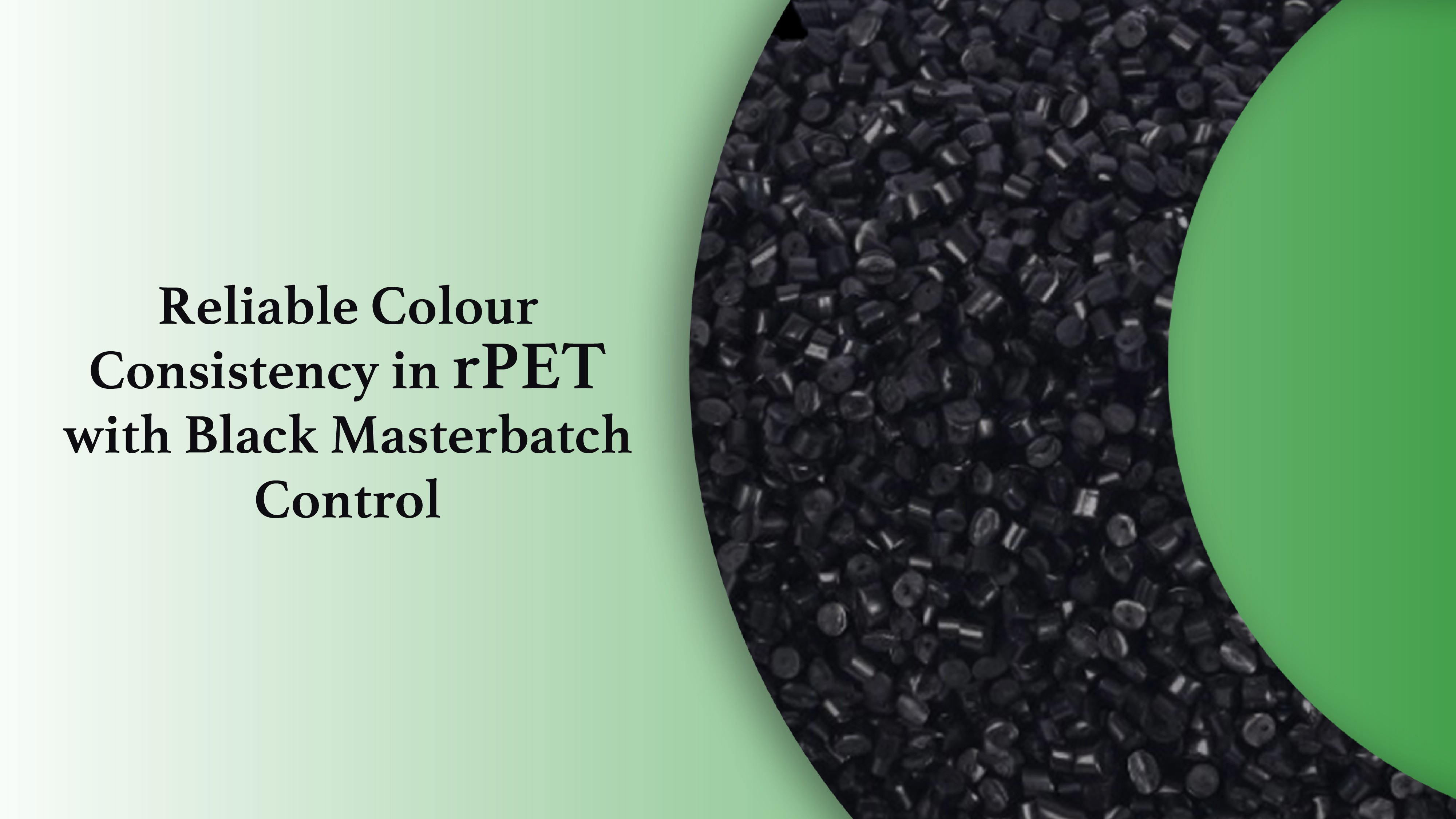
Colour consistency remains a daily challenge in recycled PET. rPET feedstock can arrive from different collection routes, different bottle designs and different previous uses. Small shifts in base tint, polymer age and trace contamination can create visible shade drift from batch to batch. Shade drift reads as quality drift on shelf, and shade drift also drives line downtime through extra changeovers and scrap.
Recycling volumes keep climbing, so colour control becomes a competitive advantage. In the United States, the PET bottle recycling rate was reported at 30.2% for 2024 by NAPCOR. In Europe, PET collection was reported at 60% in 2022, and PET beverage bottles sorted for recycling were estimated at 75%. More rPET moving through packaging and textiles raises the value of predictable colour outcomes.
Why Black Masterbatch Supports Consistency in Recycled PET
Black provides one of the clearest routes to stable aesthetics with recycled resin. A strong black system can conceal mild yellowing, light haze and subtle undertone differences that appear after repeated heat histories. Black also supports premium contrast for labels and graphics across many packaging formats.
Black masterbatch typically blends carbon black with a carrier resin and selected additives to deliver colour and performance in a controlled form. Colour consistency still depends on process discipline. Dispersion quality, dosage stability and melt cleanliness shape the final jetness. Weak dispersion leads to specks and streaks. Variable dosing shifts optical density. Excess thermal stress can push rPET toward unwanted undertones.
Step 1: Stabilise the rPET Input Before Colouring
A recycled PET black masterbatch performs best when the base resin behaves consistently.
Sorting quality and contaminant control
Tighter sorting reduces gels, dark specs and haze. Lower levels of PVC, polyolefin residues from caps, label adhesives and ink fragments improve repeatability after melting. Cleaner bale quality also supports smoother filtration and steadier pressure on the line.
Washing and decontamination discipline
Effective washing and decontamination reduce residues that trigger yellowing or surface defects. Residues can also interact with carbon black dispersion, creating a shift in perceived shade under retail lighting.
Drying control and heat history management
PET quality depends heavily on drying. Stable drying conditions reduce degradation during melting and support consistent intrinsic viscosity from run to run. Stable melt temperature and controlled residence time further protect clarity and minimise drift in base tint before pigmentation.
Step 2: Choose a PET-Optimised Black Masterbatch
A PET bottle black masterbatch designed for PET processing behaves differently from general-purpose black grades. Carrier compatibility, thermal stability and dispersion performance must match PET processing temperatures and typical line speeds.
Carrier compatibility for uniform blending
Carrier choice influences how quickly carbon black disperses into the PET melt. PET-aligned carriers support uniform distribution and a smoother surface finish, which stabilises both colour and gloss.
Carbon black selection and dispersion focus
Carbon black grade affects jetness, undertone and opacity. Higher colour strength can reduce let-down ratio and improve cost efficiency, provided dispersion remains high. Consistent dispersion also reduces specks, which is critical for premium packaging and visible consumer goods.
Performance support through additive design
Black often does more than colour. Opacity and UV stability support product protection and longer service life across many end uses. Pashupati Group positions RPET Black Masterbatch for consistent jet-black shade, improved processing and uniform dispersion across bottles, containers, sheets and fibres.
Step 3: Lock Dosing and Mixing for Repeatable Shade
Even high-performance rPET Black Masterbatches can show drift when feeding and mixing vary.
Define the target shade and fix the let-down ratio
A defined shade target should translate into a fixed let-down ratio for each product and wall section. Gravimetric dosing supports tighter control than volumetric feeding, especially when pellet bulk density shifts across rPET lots.
Strengthen blend uniformity before melting
Pre-blending rPET with masterbatch improves feed consistency into extruders, injection units and blow moulding systems. A uniform feed reduces short-term colour oscillation during start-up and during minor throughput adjustments.
Keep processing steady and clean
Stable screw speed, stable melt temperature and stable pressure help maintain dispersion quality. Melt filtration removes gels and solid contaminants that show up as visible points in black parts. Consistent hopper hygiene reduces dust and fines that can create streaks or gloss variation.
Step 4: Measure Colour Simply and Consistently
Fast feedback protects production runs from gradual drift.
Instrument checks for objective control
Spectrophotometer readings on standard plaques, film strips, or moulded samples provide repeatable colour tracking. Delta E limits can be aligned to brand requirements, then monitored across lots to detect drift early.
Line-side checks for appearance
Gloss, surface smoothness and speck count benefit from inspection under controlled lighting. A simple light box and a fixed sample thickness reveal undertone changes that remain hard to spot under mixed factory lighting.
Documentation that supports root-cause speed
Records linking rPET lot, masterbatch lot, dosing rate, drying conditions and key processing settings support rapid troubleshooting. Traceability also supports colour matching across multiple sites and multiple production weeks.
Where Consistent Black rPET Creates Value
Consistent black broadens the addressable market for recycled PET. Packaging applications include bottles, trays, caps and closures where shelf appearance matters. Sheet and thermoforming applications benefit from opacity and stable aesthetics. Fibre and textile applications benefit from uniform shade in yarn and fabric, supporting batch matching downstream.
Pashupati Group develops rPET Black Masterbatches with a focus on smooth integration with established PET converting lines and predictable dispersion control. With strong input control, PET-focused black masterbatch selection and stable line discipline, colour consistency becomes repeatable at scale, supporting higher recycled content targets without sacrificing premium presentation.
RECENT BLOGS