BLOG
POPULAR ARTICLES

/
BLOG
How Black Masterbatches Build Longer-Lasting Plastic Products
17 February, 2026

Durable plastic parts depend on consistent resin quality and stable processing. Colour also matters in products exposed to sunlight, handling, abrasion and distribution. Black masterbatches provide uniform black shade while supporting performance consistency. rPET black masterbatches help stabilise colour and output when recycled content introduces variability.
What Black Masterbatches Really Are
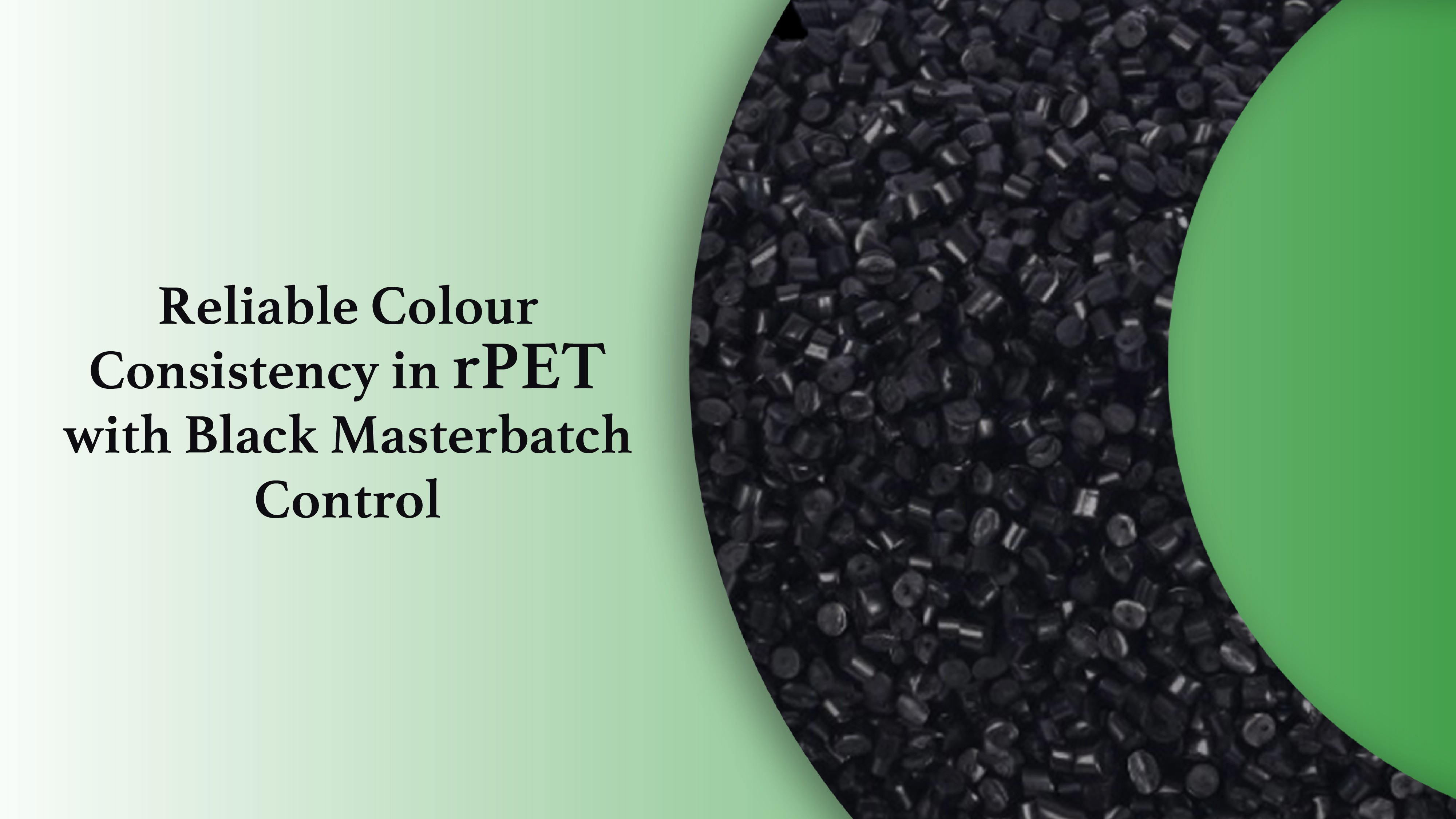
A black masterbatch is a concentrated carbon black formulation dispersed in a compatible carrier resin. It enables controlled dosing and repeatable dispersion, helping maintain consistent shade and properties across production runs. Pashupati Group frames its rPET Black Masterbatch as protection and performance wrapped in every pellet, designed for recycled PET uses such as bottles, containers, sheets and fibres.
This pelletised format matters because carbon black needs even distribution to deliver colour depth and protective benefits. Industry guidance for pressure pipe highlights that UV absorption efficiency depends heavily on particle size and dispersion during extrusion, alongside typical carbon black content ranges for UV-stable compounds.
UV Screening that Extends Service Life Outdoors
Sunlight drives heat and ultraviolet energy into polymers and that exposure accelerates ageing on outdoor products such as pipes, housings, films and agricultural items. Black masterbatch formulations act as a light screen by absorbing and scattering ultraviolet energy, helping polymer matrices resist weathering in sun-exposed environments.
Technical references from the Plastics Pipe Institute describe carbon black as a UV radiation diffuser for polyethylene pipe, with guidance that prolonged outdoor use calls for a minimum carbon black level paired with fine dispersion. Birla Carbon also links UV absorption to surface area, structure and dispersion quality.
Strength, Abrasion Resistance and Dimensional Stability
Durability also means surviving knocks, vibration and repeated handling. Carbon black can improve wear resistance in many polymers and support longer-term mechanical stability. Performance depends on dispersion quality, since uniform distribution supports more consistent protection against heat- and light-driven degradation.
For manufactured goods, these benefits show up as steadier stiffness, cleaner surfaces and better retention of functional shape over time, especially when parts see temperature cycling and friction.
Barrier Effects and Visual Consistency for Packaging
In packaging, durability includes product protection as well as physical toughness. Black masterbatches increase opacity, which can help shield light-sensitive contents through storage and transit. Pashupati Group notes barrier effects that support product quality across storage and transit cycles, alongside the premium shelf cues of a true jet black.
Colour stability also supports brand integrity. A rich black that holds across varied wall thicknesses keeps closures, bottles and injection parts consistent at point of sale and through use.
Processing Advantages that Protect Quality at Scale
Durable parts start with stable melt behaviour. Modern black masterbatches often aim for predictable rheology and consistent pellet metering, which supports steady output and tighter dimensional control. Pashupati Group highlights reduced dust, cleaner feeding, steadier dispersion and smoother film bubbles at higher line speeds as practical outcomes of well-designed black masterbatches.
When dispersion is strong, processors see fewer visible specks, more uniform gloss and cleaner edges across complex geometries. That link between dispersion and end-part performance is echoed in pipe guidance that ties UV efficiency to dispersion quality.
Why rPET Black Masterbatches Deserve Special Attention
Recycled PET brings sustainability value, plus natural variability. Feedstock history, melt history and small shifts in intrinsic viscosity can affect processing, colour and surface appearance. rPET black masterbatches help unify that variability into a repeatable outcome by delivering strong opacity and stable colour, along with processing support.
Pashupati Group positions its RPET Black Masterbatch for consistent jet-black shade, improved processing and uniform dispersion across bottles, containers, sheets and fibres. The same guidance stresses consistent dosing and mixing, with gravimetric dosing, pre-blending, melt filtration and routine colour measurement supporting repeatable shade control across production runs.
What to Look For when Specifying Black Masterbatches
Selection starts with end use, polymer platform and exposure conditions. Outdoor goods benefit from a formulation tuned for UV stability, while premium packaging often prioritises jetness, opacity and clean surfaces. Carrier resin alignment matters too, since compatibility supports dispersion and stable processing behaviour.
A practical specification workflow begins with a defined shade target and a fixed let-down ratio, then validates dispersion through simple visual checks and instrument readings. Pashupati Group describes the use of spectrophotometer readings and Delta E limits to track colour drift and protect long runs, which suits both virgin polymers and recycled streams.
It also helps to partner with suppliers who run controlled manufacturing and testing. Pashupati Group’s Shree Ram Polymers unit describes well-equipped laboratories and effective quality control systems supporting PET black masterbatches and speciality additives.
The Pashupati Group Approach to Durable Black Masterbatch
At product level, Pashupati Group emphasises that rPET black masterbatches deliver enhanced opacity, improved UV stability and uniform dispersion, with a small addition driving a big impact. At processing level, the focus is stable output, predictable melt flow and consistent feeding, which supports lower scrap and cleaner surface finish.
For converters and brand owners, rPET black masterbatches support functional consistency alongside recycled content targets. Applications include packaging, fibres and durable consumer goods where long service life and stable appearance matter.
Related Blog: The Ultimate Guide to Choosing the Best Black Masterbatch
RECENT BLOGS